


The GS1 Digital Link Transition: How Brands Are Replacing Barcodes with Smart QR Codes
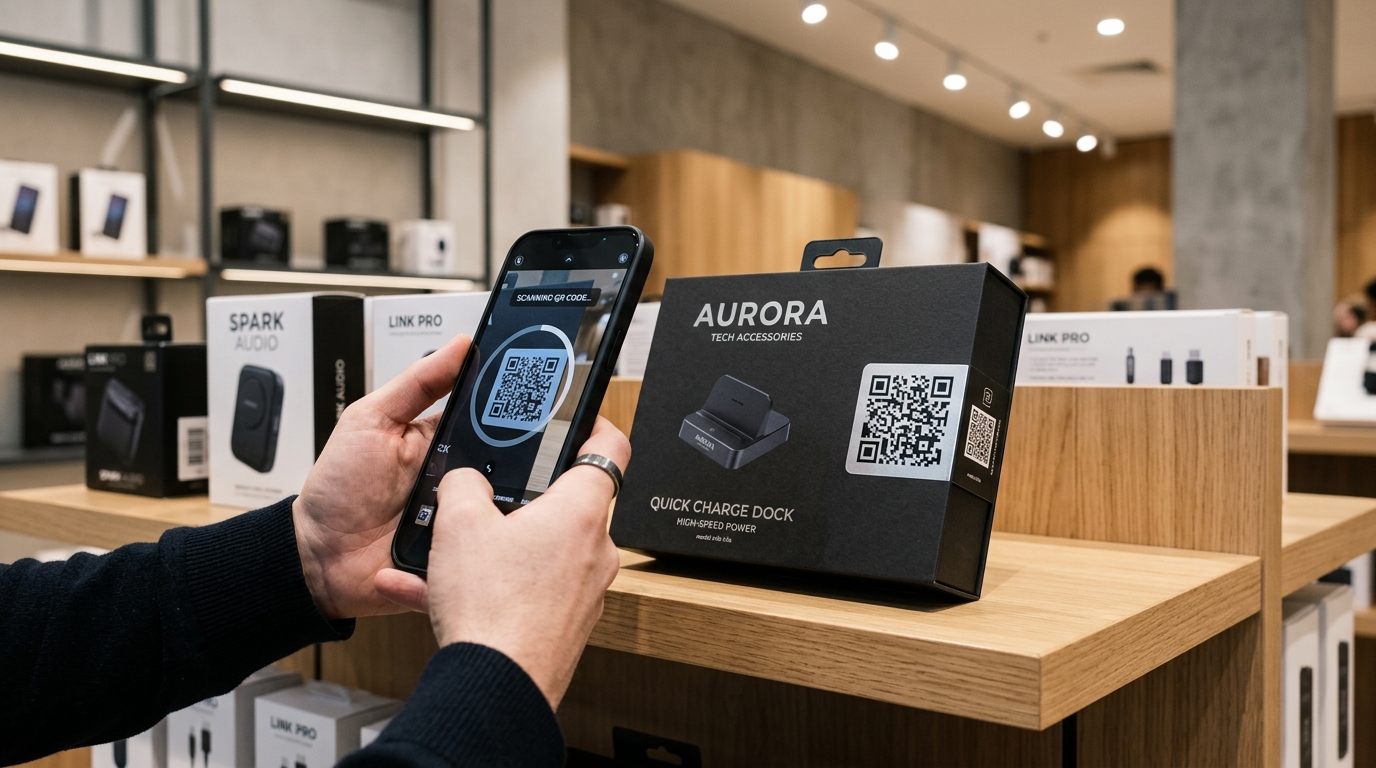
For over fifty years, the linear black-and-white 1D barcode—first scanned on a pack of Wrigley's chewing gum in an Ohio supermarket in June 1974—has served as the undisputed workhorse of global commerce. Every second of every day, billions of Universal Product Codes (UPC) and European Article Numbers (EAN) beep across retail checkouts worldwide.
Yet despite its historic success, the traditional 1D barcode has reached its technological ceiling.
A standard 1D UPC barcode encodes only 12 to 14 numeric digits: the Global Trade Item Number (GTIN). It cannot convey batch identifiers, production lot numbers, expiry dates, provenance certificates, allergen warnings, or digital user manuals. To compensate, modern brands have spent years cluttering their product packaging with two separate codes:
- A traditional 1D UPC barcode for cashiers and inventory management.
- A separate marketing QR code for smartphone-toting consumers seeking brand stories, recipes, or warranty registrations.
This dual-barcode clutter wastes valuable packaging surface area, creates visual confusion for shoppers, and forces cashiers to fiddle with scanners when the wrong code is accidentally read at checkout.
All of that is about to change. Under the global industry initiative known as GS1 Sunrise 2027, standards body GS1 and the world's largest retailers (including Walmart, Target, Carrefour, and Wegmans) are executing a historic transition: replacing 1D barcodes at point-of-sale (POS) registers with standardized 2D QR codes powered by the GS1 Digital Link standard.
In this guide, we break down what the GS1 Digital Link transition means for consumer packaged goods (CPG) brands, how a single 2D code simultaneously powers supermarket checkout and mobile engagement, and how you can prepare your packaging workflow using QR Zam.
What is GS1 Digital Link? (And How Does It Work?)
The GS1 Digital Link is a global standard that upgrades traditional GS1 identifiers into standard web-resolvable URLs.
Instead of encoding an isolated, opaque number into a linear barcode, a GS1 Digital Link encodes a web URI structure that embeds the product's GTIN along with granular supply chain data keys (Application Identifiers or AIs).
https://id.yourbrand.com/01/00850012345678/10/LOT-987?17=271231&21=SER-54321
Deconstructing the GS1 Digital Link URI Architecture
| Component | Example in URI | GS1 Application Identifier (AI) | Functional Purpose |
|---|---|---|---|
| Branded Domain | id.yourbrand.com | N/A | Establishes brand authenticity and routes through a dynamic resolver engine |
| GTIN (Barcode Number) | /01/00850012345678 | AI (01) | The unique 14-digit Global Trade Item Number scanned by POS cash registers |
| Batch / Lot Number | /10/LOT-987 | AI (10) | Tracks exact manufacturing batches for food safety and product recalls |
| Expiration Date | ?17=271231 | AI (17) | Encodes date (YYMMDD format) to prevent retail sale of expired goods |
| Item Serial Number | &21=SER-54321 | AI (21) | Unique unit serialization for luxury authentication and anti-counterfeiting |
The Power of Dual-Functionality
What makes GS1 Digital Link revolutionary is its dual-function capability:
- At the Supermarket Checkout Counter: When a modern optical POS bioptic scanner reads the 2D code, its decoding software extracts the embedded GTIN
(01)to instantly ring up the item price, decrement inventory, and flag any expired batch alerts. - In the Hands of a Consumer: When a customer points their everyday iPhone or Android camera at the exact same printed code, the phone opens the URL in their mobile browser, launching a dynamic, context-aware brand landing page.
One single code on the box replaces the legacy barcode and the marketing QR code forever.
5 Compelling Reasons Brands Are Transitioning to GS1 2D Codes Before 2027
While GS1 has established 2027 as the landmark year when retail POS systems must be capable of scanning 2D barcodes, industry leaders are not waiting. Here is why forward-thinking brands are switching today:
| Scanning Channel | Hardware / Reader | Decoded Data & Action | Real-World Operational Outcome |
|---|---|---|---|
| 🛒 Retail POS Checkout | Optical 2D bioptic cashier scanner | Truncates to GTIN (01) + Expiry (17) | Instant cashier beep, automated inventory decrement, and expired lot intercept |
| 📱 Consumer Smartphone | Standard iOS / Android camera app | Resolves full GS1 Digital Link URL | Interactive digital portal: allergens, traceability, sustainability, and 1-tap reorders |
1. Reclaiming Valuable Packaging Surface Area
Packaging designers fight for every square millimeter. Removing the bulky 1D UPC barcode frees up substantial canvas space on cans, pouches, medicine bottles, and cosmetic cartons. A single, compact 2D QR code satisfies regulatory compliance, retail logistics, and consumer marketing in a fraction of the space.
2. Digital Product Passports (DPP) & Global Compliance
Under the European Union's Ecodesign for Sustainable Products Regulation (ESPR) and the FDA's Food Safety Modernization Act (FSMA Rule 204), brands face stringent traceability mandates. Companies must disclose material composition, carbon footprints, supply chain tiers, and recycling directives. GS1 Digital Link provides the standardized web infrastructure to deliver this compliance data on demand without continuously revising physical packaging copy.
3. Granular Batch-Level Recall Management & Expiry Interception
Food and pharmaceutical safety incidents cost companies millions in legal damages and brand trust. Because GS1 Digital Link QR codes can encode batch numbers (10) and expiration dates (17):
- POS scanners can automatically refuse checkout if a package belongs to an expired lot or a recalled batch.
- If a consumer scans a tainted item at home, the dynamic landing page displays an urgent warning with instant refund instructions, shielding customers from illness.
4. Interactive Sustainability & Hyper-Local Recycling Guides
Recycling rules vary widely from municipality to municipality. By routing scans through a dynamic geo-location resolver like QR Zam, the landing page detects the scanner's city or postal district and provides localized curbside sorting instructions: whether the cap goes into plastics, the bottle into clear glass, or the outer carton into compost.
5. High-Margin DTC Reorders, Loyalty, and Anti-Counterfeiting
Physical retail sales have historically been an attribution blind spot. When a customer scans a GS1 QR code on their shampoo bottle in their shower:
- They can initiate a one-tap subscription reorder.
- They can join your brand's digital VIP loyalty rewards program.
- For luxury cosmetics, apparel, and spirits, serialized codes
(AI 21)verify the product's cryptographic authenticity, crippling counterfeit grey-market resellers.
Comparison: Traditional 1D Barcode vs. GS1 Digital Link 2D QR Code
| Capability / Attribute | Traditional 1D UPC / EAN Barcode | GS1 Digital Link 2D QR Code |
|---|---|---|
| Data Capacity | 12 to 14 numeric digits only | Over 3,000 alphanumeric characters |
| Retail POS Checkout | Yes (Laser or image scanners) | Yes (Modern 2D camera bioptic scanners) |
| Consumer Smartphone Scanning | No (Requires specialized third-party app) | Native (Scanned automatically by standard camera) |
| Batch / Lot Serialization | Impossible without secondary text | Supported natively via GS1 Application Identifiers |
| Post-Print Content Updates | No (Completely static) | Fully dynamic via cloud resolver redirection |
| Multimedia & Digital Interactivity | None | Full mobile web apps, video demos, recipes, reviews |
| Packaging Footprint | Large rectangular footprint (approx. 37 x 26 mm) | Compact square footprint (can scale to 12 x 12 mm) |
| Error Correction & Redundancy | Low (Scratches or tears ruin scan) | High (Up to 30% damage tolerance via Reed-Solomon) |
The GS1 Resolver Architecture: How Dynamic Routing Works
At the heart of the GS1 Digital Link ecosystem sits the Resolver Engine.
A resolver is a cloud-based web routing service that evaluates the incoming scan and decides where to direct the user based on context rules, headers, and device telemetry:
| Scan Origin / Request Context | Resolver Evaluation Rule | Delivered Destination & Payload |
|---|---|---|
| 🇺🇸 US Consumer (English) | Geo-location (US) + Accept-Language: en | English recipe videos, local retail store locator, and USD reorders |
| 🇪🇺 EU Consumer (French) | Geo-location (EU) + Accept-Language: fr | French nutritional disclosures, allergen warnings, and local recycling guide |
| 🏢 Enterprise ERP / Scanner | Header Accept: application/json+ld | Raw GS1 structured JSON-LD product data for automated warehouse intake |
Real-World Resolver Routing Scenarios:
- Language & Regional Localization: A French traveler scanning an American snack in Paris is automatically served nutritional disclosures and allergen warnings in French, while a shopper in Texas sees English video recipes and a local store locator.
- Lifecycle State Management: While a product is on the store shelf, the code highlights promotional discounts and influencer endorsements. After purchase, the brand can dynamically update the destination to focus on product registration, tutorials, and subscription replenishment.
- Application Protocol Resolution: When an enterprise inventory tablet running a warehouse management system requests
Accept: application/json+ld, the resolver returns machine-readable JSON product data. When an iOS Safari browser requests the same URL, it returns an engaging, responsive HTML5 mobile experience.
5-Step Action Plan: How Brands Can Prepare for GS1 Sunrise 2027
Transitioning packaging across an entire SKU lineup takes between 6 and 18 months, encompassing prepress proofs, rotogravure printing cylinder re-engraving, and supply chain trials. Here is the recommended roadmap:
Step 1: Audit Your Current GTIN Allocations
Catalog every active product SKU, verifying that your company's GS1 Company Prefix and assigned GTIN-12 or GTIN-13 numbers are properly registered and compliant in GS1 GEPIR databases.
Step 2: Establish Your Branded Resolver Domain on QR Zam
Never use generic shared URL shorteners on retail consumer packaging. Set up a dedicated corporate subdomain such as:
https://id.yourbrand.com
Pairing your enterprise domain with QR Zam's Dynamic QR Code Platform guarantees brand authority, SSL certificate compliance, and uninterrupted redirection speeds with 99.99% uptime SLA.
Step 3: Configure Contextual Redirection Rules
Inside your QR Zam dashboard, establish intelligent fallback and geo-routing rules:
- Connect default consumer scans to a high-converting mobile micro-site.
- Add product registration forms, warranty lookups, and one-click customer support channels.
- Configure webhooks to pipe offline scan analytics directly into your Salesforce, HubSpot, or Klaviyo marketing automation flows.
Step 4: Follow Prepress Printing & Sizing Standards
When placing 2D QR codes on physical packaging, follow strict GS1 mechanical guidelines:
- Minimum Dimensions: Ensure the printed QR code is at least 13 x 13 mm (0.5 x 0.5 inches) for high-speed automated checkout conveyor belts and handheld retail scanners.
- Quiet Zone Margins: Maintain a minimum quiet zone margin equal to 4 individual data modules on all four sides. Never allow product photography, borders, or typography to bleed into this border.
- Contrast & Print Reflectance: Stick to dark data modules (solid black, deep navy, or forest green) against a clean white, opaque background. Avoid metallic inks, foil stamping, or specular gloss finishes that scatter laser beams.
- Vector Assets Only: Always export your print-ready masters in SVG or lossless vector PDF to eliminate jagged raster pixels during plate making.
Step 5: Conduct Dual POS and Smartphone Lab Verification
Before rolling out 100,000+ unit packaging runs:
- Test scan proofs using mainstream commercial handheld POS barcode scanners (Zebra, Honeywell, Datalogic) to confirm clean GTIN decoding.
- Scan across low-end and flagship iPhone and Android devices under various ambient lighting conditions (bright fluorescent supermarket lighting, dim household kitchens, and outdoor sunlight).
Frequently Asked Questions (FAQs)
1. Will traditional 1D barcodes immediately stop working on January 1, 2027?
No. Sunrise 2027 represents the target date by which point-of-sale systems must be capable of processing 2D barcodes at checkout. The retail ecosystem will operate in a phased, hybrid transition period. However, major retailers are actively prioritizing brands that adopt 2D codes early because it reduces checkout friction and supports automatic product expiration management.
2. Can a GS1 Digital Link QR code be scanned without an internet connection?
At retail point-of-sale checkouts, the optical scanner decodes the embedded GTIN locally within the register hardware—no internet access is needed to ring up the item price. For consumers using smartphones, an internet connection is required to load the digital web landing page.
3. How does GS1 Digital Link assist with counterfeit prevention?
By incorporating serialized identifiers (AI 21) into each unique unit's dynamic QR code, brands create an unforgeable digital twin. When scanned, the system verifies whether that specific serial number has been registered or flagged as unauthorized, alerting both the consumer and brand security teams in real time.
4. Can I customize the visual appearance of a GS1 2D QR code with logos and brand colors?
Yes! While POS bioptic scanners require adequate contrast and clear finder patterns, GS1 Digital Link codes generated with QR Zam support customized color palettes, rounded module shapes, and subtle brand logos centered in the code matrix while maintaining full ISO/IEC 18004 scanning compliance.
Transform Your Packaging into a Digital Channel with QR Zam
The sunset of the 50-year-old 1D barcode is the biggest upgrade in retail history. Brands that embrace the GS1 Digital Link standard not only future-proof their supply chains for Sunrise 2027, but also unlock a direct, high-margin relationship with millions of shoppers right at the point of unboxing.
Ready to lead the 2D smart packaging revolution? Get started with QR Zam to create enterprise-grade, GS1-ready dynamic QR codes with real-time routing, custom domains, and end-to-end consumer analytics today.